Pending: The political economy of waiting
The loading screen is the most powerful weapon in the modern state

We are conditioned to view the pending status as a neutral gap—a technical pause while the system works. But in the modern administrative state, “pending” is the answer.
![A triptych photograph showing three different digital interfaces that illustrate bureaucratic failure. On the left, an older, thick-bezel LCD monitor displays a dark screen with a pixelated white progress bar stuck at "99%." Below it, a chunky loading spinner rotates, and green, blocky text reads: "STATUS: PROCESSING APPLICATION... ESTIMATED TIME REMAINING: CALCULATING...". The top-right panel is a close-up of a glowing blue screen showing a digital form. A required field labeled "* LIVING SITUATION / DEPENDENTS" has a drop-down menu where only the option "[X] NUCLEAR FAMILY (Spouse + <2 Dependents)" is available. Below it, a red error message box states: "ERROR 422: UNPROCESSABLE ENTITY. YOUR NARRATIVE DOES NOT MATCH REQUIRED SYNTAX. TRY AGAIN.". The bottom-right panel shows a tablet screen with an overflowing email inbox. The entire list consists of identical, repetitive unread messages: "> [NO-REPLY] Case #99402B Status Update: IN PROGRESS (10:01 AM)". In the bottom-right corner of the tablet screen, a small widget labeled "Ticket Status" has a green light and the text "ACTIVE (Last Action: Today)".](https://substackcdn.com/image/fetch/$s_!yfSI!,f_auto,q_auto:good,fl_progressive:steep/https%3A%2F%2Fsubstack-post-media.s3.amazonaws.com%2Fpublic%2Fimages%2F63380bea-1ae6-4d0f-bb3f-59ab8d7880bc_2816x1536.png "A triptych photograph showing three different digital interfaces that illustrate bureaucratic failure. On the left, an older, thick-bezel LCD monitor displays a dark screen with a pixelated white progress bar stuck at \"99%.\" Below it, a chunky loading spinner rotates, and green, blocky text reads: \"STATUS: PROCESSING APPLICATION... ESTIMATED TIME REMAINING: CALCULATING...\". The top-right panel is a close-up of a glowing blue screen showing a digital form. A required field labeled \"* LIVING SITUATION / DEPENDENTS\" has a drop-down menu where only the option \"[X] NUCLEAR FAMILY (Spouse + <2 Dependents)\" is available. Below it, a red error message box states: \"ERROR 422: UNPROCESSABLE ENTITY. YOUR NARRATIVE DOES NOT MATCH REQUIRED SYNTAX. TRY AGAIN.\". The bottom-right panel shows a tablet screen with an overflowing email inbox. The entire list consists of identical, repetitive unread messages: \"> [NO-REPLY] Case #99402B Status Update: IN PROGRESS (10:01 AM)\". In the bottom-right corner of the tablet screen, a small widget labeled \"Ticket Status\" has a green light and the text \"ACTIVE (Last Action: Today)\".")
It shifts authority away from the moment of decision, where a human being must look you in the eye and say “no,” and hides it in the architecture of the interface, where no one has to say anything at all.
This is a shift from judgment to syntax. The power to destroy a life no longer requires a verdict; it only requires a loading screen.
The Form is the Gatekeeper
In older bureaucracies, power was exercised through the event. The judge banged the gavel; the clerk stamped “DENIED.” It had an author. You could point to the person who rejected you and demand a reason.
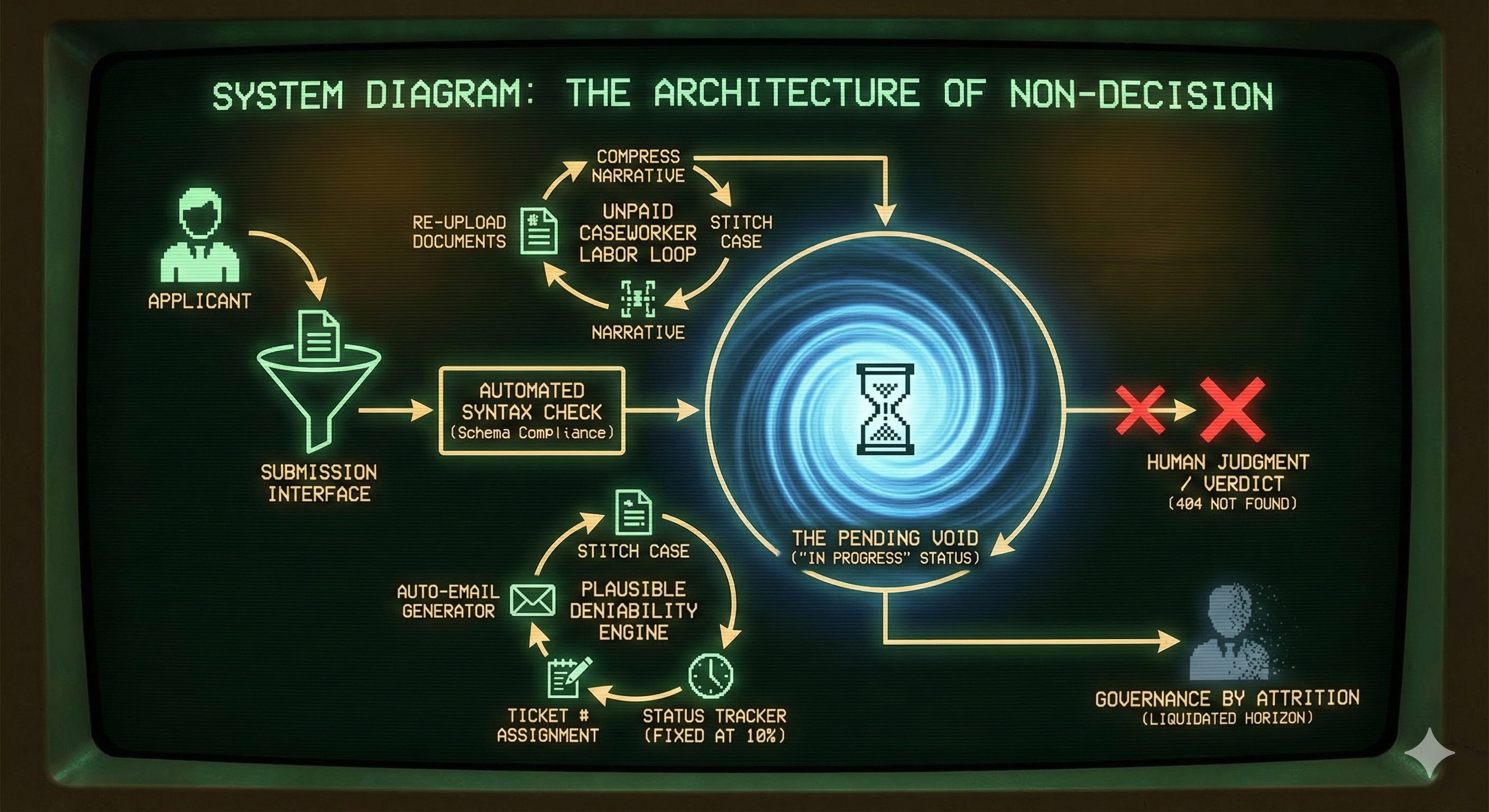
In digital bureaucracy, the rejection happens before you even submit. Politics has migrated into the schema design: the drop-down menus, the required fields, the file-size limits.
The institution no longer needs to argue with you. It only needs to fail to recognize your format.
If your life is too messy for the categories provided—if your employment history doesn’t fit the box, or your family structure defies the drop-down—you are not formally rejected. You are simply unprocessable. You hang in the void, waiting for a validation check that will never come.
The institution doesn’t need to be cruel. It just needs to be slow.
The Lie of “Efficiency”
We are told that moving services online makes them efficient. This is a lie. It is merely cost-shifting.
“Pending” transforms the applicant into an unpaid caseworker for their own survival. The labor of maintaining the file is exported entirely onto the vulnerable.
You must compress your narrative into keywords.
You must re-upload the documents when they expire.
You must stitch the case back together every time the system dissolves it.
The institution appears efficient on its spreadsheet only because it has offloaded the cost of its own memory onto the person whose life is at stake.
Plausible Deniability
The modern system’s greatest weapon is not silence, but noise.
The system is incredibly talkative. It sends automated emails. It generates ticket numbers. It offers status trackers that sit endlessly at 10%. It performs responsiveness to mask the fact that it has suspended all obligation.
By keeping the ticket open, the institution maintains its moral vanity. It never has to be the “bad guy.” It never has to issue a hard denial that could be appealed or sued over. As long as the status is “In Progress,” they can claim they are helping you, even as they slowly bleed out your time.
Governance by Attrition
For the wealthy, a delay is a nuisance. For the precarious, a delay is a denial.
When the scholarship deadline passes, the surgery window closes, or the eviction notice arrives while the application is “under review,” the system has made a decision without ever issuing one.
This creates a class of the future-poor—people whose horizons are continuously liquidated by the wait.
This is governance by attrition. The system doesn’t have to exclude you; it only has to make you carry the weight of the process until you drop it. It manages scarcity not by saying “No,” but by waiting for you to give up.