Incidence Is Not Suffering

Writers such as Steven Pinker, Hans Rosling, Johan Norberg, Max Roser, Tyler Cowen, and Tim Urban have spent much of the last decade popularizing a specific narrative about the modern world: that it is getting fundamentally better. This case typically rests on long-term data showing that the frequency of major human harms—war, extreme poverty, child mortality, and various forms of violence—has declined significantly. While these trends are verifiable and important, they rely on a metric that captures only the incidence of harm, or the specific moment a problem begins.
What this perspective largely overlooks is the duration of suffering. Because human beings do not experience harm as an isolated event on a timeline, but rather as time spent living through a crisis, the incidence of a problem tells us very little about its total impact.
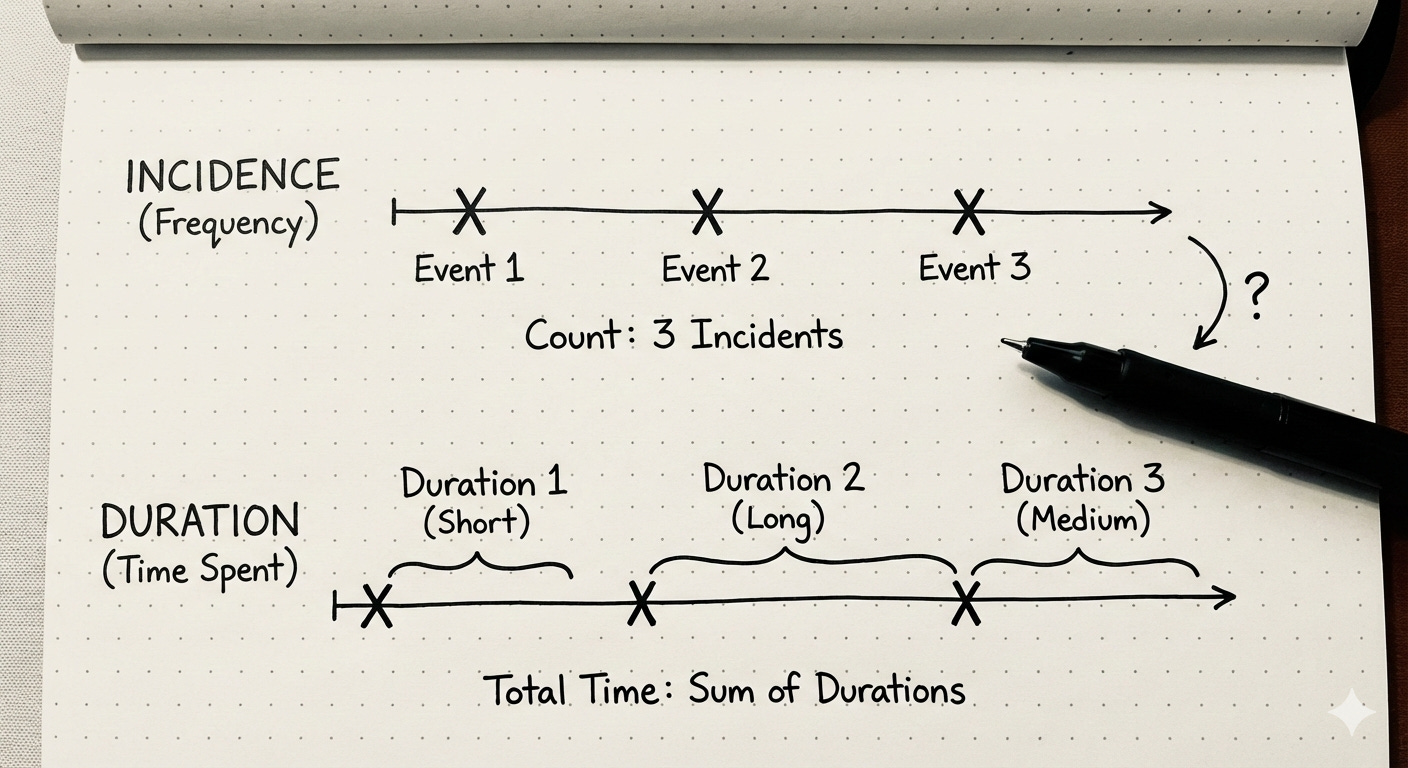
The harm of a frozen bank account, for instance, is not contained within the instant the freeze occurs; it is the cumulative experience of the weeks or months during which a person is denied access to their resources. Similarly, an immigration backlog might appear in a database as a single case entry, but for the individual inside it, that entry represents years of suspended autonomy. From the system’s perspective, these are incidents; from the person’s perspective, they are stretches of life.
We can see this distinction in the administrative systems that organize modern life. Failures rarely arrive as dramatic, singular events. Instead, they take the form of “pending” states: fraud investigations, visa applications, insurance appeals, or benefit claims. From an institutional perspective, these are often treated as neutral procedural queues where a file enters and eventually produces an outcome. From the inside, however, the waiting is often the harm itself. While a case remains unresolved, a person may be unable to work, travel, access money, or receive medical treatment. The system sees a file awaiting resolution, but the person experiences months or years of a life lived in precarity.
Once we account for duration, a measurement paradox appears: it is entirely possible for a society to reduce how often people encounter certain problems while simultaneously extending how long those problems last.
We can effectively create a world with fewer entries into hardship, but significantly longer “sentences” for those who do fall through the cracks.
Consider two hypothetical societies. In the first, administrative errors are common but are corrected within a week. In the second, such errors are much rarer, but the systems responsible for correcting them move so slowly that a mistake takes three years to resolve.
If we only count the frequency of incidents, the second society appears to be the more progressive one.
However, if we measure the total amount of human time spent inside those harms, the first society might actually be the more humane.
Yet, public arguments about progress continue to rely almost exclusively on the first metric. By treating declining rates of poverty or disease as proof that suffering is shrinking, we overlook the “time-tax” of institutional failure. A backlog is not merely a list of cases; it is an accumulation of human time spent waiting for relief. Every stalled application or delayed appeal represents months or years during which a life remains constrained. In the standard statistical narrative, this time effectively disappears because the harm has already been “counted” at its inception.
Ultimately, if duration is factored into our understanding of progress, the story becomes much harder to summarize with a single downward line on a chart.
Reducing the frequency of harm is a vital goal, but it is only half of the story. The other half is how quickly people can escape once harm begins. Progress should be measured not only by how rarely a life is disrupted, but by how much of that life is allowed to be consumed once the disruption occurs.
Incidence tells us how often harm begins.
Duration tells us how much life it takes.