If Every User Is a Potential Threat...
People are not becoming inherently dishonest, lazy, or cynical. They are becoming game-theoretically optimal for the environment they have been placed in.

We are witnessing the quiet inversion of the most fundamental operational principle in society: the presumption of innocence.
For centuries, the social contract was built on a default setting of trust. You were assumed to be who you said you were, and you were assumed to be acting in good faith until you broke a rule. The burden of proof lay on the accuser.
That architecture has been replaced.
In the digital world, the default setting is now “Zero Trust.” This is a cybersecurity concept that has leaked into governance. In a Zero Trust architecture, no entity—inside or outside the perimeter—is trusted by default. Every request must be verified. Every interaction is conditional. Every user is treated as a potential threat until they perform the “proof of work” required to establish a temporary state of innocence.
This change was not motivated by ill will; it was a result of calculations.
When you operate at the scale of billions, the “tail” of bad actors—spammers, fraudsters, state-sponsored hackers—is numerically larger than the entire population of most countries.
To a system administrator, the volume of attack traffic is indistinguishable from the volume of legitimate traffic.
So, the system adapts. It builds a defensive wall that treats everyone as adversarial. The result is a society running on a new operating system: Guilty Until Verified.
The Asymmetry of Trust
The defining feature of this new regime is “Asymmetric Irreversibility.”
Modern institutions have automated the power to suspect, but they have not automated the power to exonerate. A fraud filter can freeze a bank account in milliseconds. A content moderation bot can ban a decade-old creative business in the time it takes to render a pixel.
These systems operate at machine speed, with zero marginal cost per decision.
But correction operates on human time.
To fix the mistake, you must navigate a reversal path that is manual, scarce, and expensive. You must file tickets, wait on hold, upload documents, and plead with agents who often lack the authority to override the machine.
This creates a terrifying structural reality: The system can destroy your status instantly and for free, but restoring it costs you days of your life.
Because the institution pays nothing for the error, and you pay everything for the correction, the system learns a brutal lesson: it is always safer to block a good user than to let in a bad one. False positives are just “friction” for you; false negatives are “risk” for them.
The Rationing of Justice
Under this logic, “due process” ceases to be a right and becomes a scarce resource.
Because human review is expensive, it is rationed. It is saved for the users who matter—the wealthy, the verified, the “continuous.” If you have a stable address, a ten-year phone number, a consistent biometric profile, and a standard income, you pass the friction filters. You have “slack.”
If you are poor, transient, unbanked, or irregular, you trigger the immune system. You fall into the “tail.” And because you lack the resources to endure the reversal process, you are not just delayed; you are exiled.
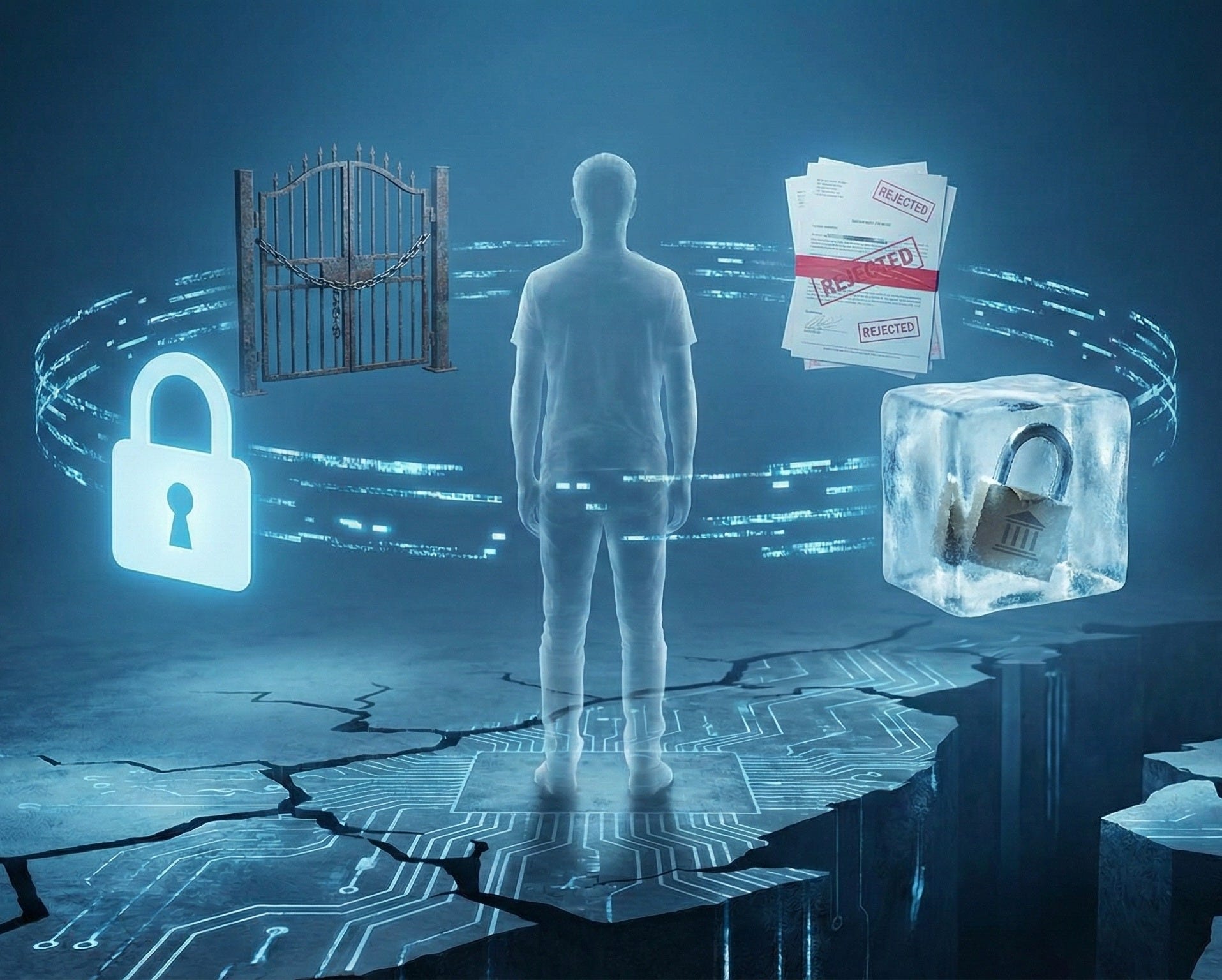
We are seeing the rise of Administrative Homelessness: a class of people who are biologically alive but systemically dead. They cannot rent because of a zombie eviction record. They cannot work because of a background check error. They cannot bank because of a fraud flag. They are trapped in the database’s blind spot, unable to prove they exist.
The Rationality of Bad Behavior
This hostile architecture explains the bewildering shift in modern behavior. We are not watching a moral collapse; we are watching a rational adaptation to a system that assumes we are enemies.
Cheating becomes rational.
When the official recovery form is a dead end, but a bribe to a “dark web” consultant works, honesty becomes a survival disadvantage. If the system doesn’t play by the rules (it bans you without cause and refuses to hear your appeal), why should you? Cheating is no longer deviance; it is the only remaining form of agency.
Rage becomes pointless.
Anger is a social signal intended to shame the community into enforcing standards. But you are screaming at a mechanism. A “No-Reply” inbox cannot feel shame. A chatbot cannot be intimidated. Rage requires a recipient, and the system has designed itself to be un-reachable.
Politeness becomes humiliating.
To get help, you must perform submission. You must say “please” and “thank you” to the very entity that is destroying your livelihood. You must validate the system’s “Theater of Care”—the empathy scripts, the apology emails—just to keep your ticket open. It feels humiliating because it is humiliating: you are performing compliance to your own abuse.
Withdrawal starts to seem like the only sane move.
If every interaction carries a 0.1% chance of an uncorrectable “death penalty” (a lifetime ban, a frozen wallet), the only winning move is not to play. People stop posting. They stop verifying. They stop experimenting. They standardize their lives to fit the machine’s narrow template of a “good user.”
The Mirror
We are building a world where correctness is a luxury good, available only to those who can afford the “premium” tier of human support.
For everyone else, there is only the algorithm, which sees the world through a single, paranoid lens.
If the system treats every user as a potential threat, eventually the users return the favor. We stop trusting institutions. We assume every form is a trap, every delay is a lie, and every rule is a weapon.
We are not losing our values. We are simply mirroring the machine.
Yes, yes! Negarestani's Cyclonopedia explains in-depth how White War and Hypercamouflage have made the system exist only against (and to create) Jihad. The dissolution of trust plays right into the hypercamouflage of Taqqiya-ist thought by being on a permanent combative posture. This will not end well for either camps; the western world's authorities are devolving further into the death cult of solar immanence and will lead to naught but a societal desert.