Institutional Apoptosis
Designing systems that know when to end

We are excellent at birthing new institutions—agencies, committees, regulations—but we have no mechanism for metabolizing them. We treat governance as a process of permanent accumulation. A challenge arises, we build a structure to solve it, the challenge evolves, but the structure remains. It accumulates staff, budget, and procedural weight.
The result is “sedimentary governance”: layers of older solutions sitting beneath new ones, slowing down the entire stack.
Think of a housing crisis layered over 1970s zoning law, 1990s environmental carve-outs, and 2008-era foreclosure relief programs—each one still half-alive in the codebase.
We end up running 21st-century software on 20th-century hardware, weighed down by 19th-century assumptions about permanence.
Biology solved this problem eons ago.
In a healthy organism, death is not a failure; it is a maintenance function. The process is called apoptosis: programmed cell death.
When a cell is damaged or simply obsolete, it doesn’t wait to be killed by external trauma. It initiates a specific sequence. It dismantles its own machinery, packages its resources, and signals its neighbors to recycle its matter. The exit is clean. The system remains stable.
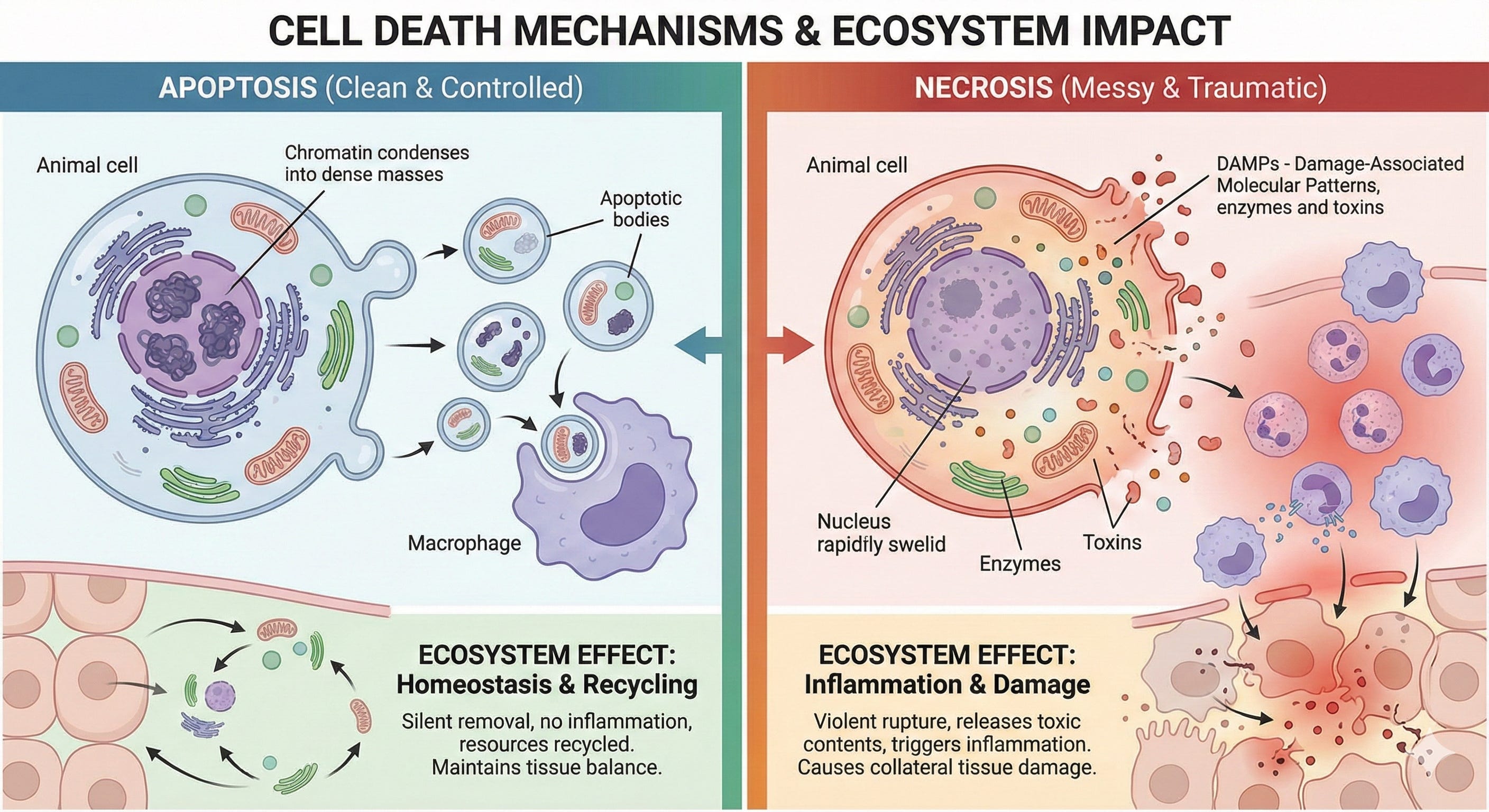
The alternative is necrosis—traumatic, inflammatory rupture. Or worse: the cell refuses to cycle out at all, replicating without purpose until it destabilizes the host. In biology, we call that uncontrolled growth. In politics, we call it “bureaucracy,” but the mechanic is the same: the part prioritizes its survival over the health of the whole.
We have built a specific type of fragility into our society by designing institutions that can only end via necrosis (collapse/crisis) rather than apoptosis (resolution).
Coding for Mortality
If apoptosis is how a body stays healthy, we need the equivalent in law. That means shifting from Statutory Permanence to Statutory Provisionality: nothing runs forever by default. Every institution ships with an end-state baked into its code.
Expiration by Default
Every charter, agency, and program should carry the genetic code for its own conclusion. Not a vague “review in five years,” but a real sunset. The default state of any government program should be winding down unless it can affirmatively prove it is still doing necessary work.The Burden of Proof
Right now, closing a zombie agency takes enormous political capital. Inertia protects the status quo. Apoptotic design flips the friction: renewal is what takes effort. If a directorate created to reduce homelessness sees homelessness rise for five years, it shouldn’t require a special vote to defund it. The funding falls off because the metrics were missed. The resolution is in the code, not in a heroic last-minute fight.The Graceful Exit (Recycling)
We fear institutional death because we imagine a void—lost jobs and vanished services. That’s necrosis. An apoptotic ending is planned. Assets are transferred or sold to nonprofits and local actors. Civil servants move into a “talent reserve” for new projects instead of being scattered. Data is archived and made usable. The institution doesn’t crash; it resolves.
Metabolic Governance
The resistance to this is largely cultural: we tend to view endings as moral verdicts. Shutting down an agency looks like admitting it was a mistake. Sunsetting a law looks like disowning the values that created it.
So we choose the comfortable drift of irrelevance over the clarity of a conclusion. We tell ourselves this is compassionate. It isn’t—not for the people trying to live and work inside these obsolete structures. There is nothing compassionate about a public forced to navigate systems that no longer fit the world. There is nothing kind about trapping talented workers inside organizations that cannot succeed.
A forest that suppresses every small fire eventually burns down. A body that refuses to recycle its cells eventually sickens. True stability is not the absence of change; it is the ability to metabolize the old to make room for the new.
The 20th century was about building institutions that could last forever. The 21st century needs to build institutions that know how to die. We should be testing systems for how well they end, not just how well they scale.